

Footnotes to Goldziher

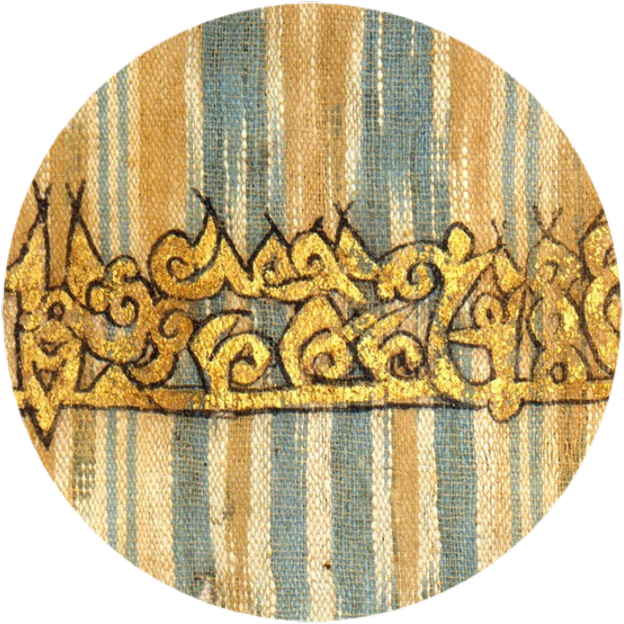
The Textile Museum, Washington, D.C.
My research has entered the crucial phase where I crawl through five pages by Ignaz Goldziher (1850–1921) on the subject of poetry and textiles. Since an early encounter with Mythology Among The Hebrews—a brash work of his 26th year, full of pre-structuralist thrills and spills of the kind you find in The Golden Bough of fourteen years later—I've been in awe of this scholar. To claim him as a predecessor would be arrogance enough, and now it's my job to check his work? But it's necessary, because the footnotes to these five pages from his 1896 essay on "Old and New Poetry in the Estimation of Arab Critics" are an absolute treasury of testimonia on the fiber arts, in particular the Yemeni robe called al-ḥibara and its cognates (muḥabbar, taḥbīr, etc). It is marvelous evidence, over fifty citations' worth, and tracking them down has increased my admiration for Goldziher, even as my interpretations clash with his.
Since I began this project, it's bothered me that I would have to critique Goldziher, but I'm more serene about it now. To center his work of 130 years ago and devote this much attention to it is the greatest tribute I'm able to pay.

Library of the Hungarian Academy of Sciences, MS. 10.206/39

To begin, I say yet again that no answer can be wrong, if the question be "How is a poem like a woven thing?" I also warn against projecting private intuitions onto tradition globally. Whatever connection between texts and textiles you believe in, it is risky to assume your hunch is everywhere true.
Goldziher's answer is explained with perfect clarity. What poetry has in common with robes of prestige manufacture is Schema, that is, "structure." It is due, he says, to the structural patterning of the pre-Islamic ode's components that such poems are compared to richly-patterned garments. And for many devotees of qasida poetry in Arabic—typically, a polythematic production punctuated by transitions that can be quite inventive—Goldziher's explanation suffices. If they review the evidence, though, they'll find that when early Arab poets compare their work to luxury mantles, it's not poetic form they talk about but poetic function, and the social efficacy of their praise and blame. To appreciate this, you have to read Goldziher's tersely-quoted evidence in the context of whole poems.
One of these I blogged in January: "I will help you out with taḥbīr of poetic odes" says al-Hakam ibn ‘Abdal to his cellmate. The phrase seems to suggest a long and intricate composition, which Goldziher takes at face value (I.129n4). But the poem is short, just five lines long, and very far from "high" qasida style. In the form in which we have it, the poem is an invective brief that regrettably (but sensibly) omits the name of the poet's jailer.
Al-Hakam is the earliest of Nefeli Papoutsakis's begging poets, and as far as I know he left behind no long-form odes in the classical mode. His most famous poem is has talking cartoon animals in it. Al-Hakam ibn ‘Abdal was an amazing poet, but emphatically not in the style Goldziher thought the taḥbīr of poetry to be.

Goldziher's prime example of the weave of poetry is al-ḥabīr al-musalsal, an evocative phrase from the Hudhalī diwan. Musalsal derives from silsila "chain," which Goldziher interprets as a metaphor for co-intrication of a poem's component parts. This is inconsistent with his (correct) reading of mirṭ muraḥḥal in the magnum opus of Imru’ al-Qays as "a cloak decorated with saddlery designs" (I.130n4). In accordance with that reading (and its well-attested paradigm), musalsal describes a robe that is "decorated with chainlike forms." But what does it mean for a poem to be decorated in this way?
For an answer, we may consult the rest of the poem likening itself to al-ḥabīr al-musalsal in the first verse. The poem is tricky, because it exists in at least two versions—one with 11 verses, the other 8—from two different recensions of the poems of the Hudhalī tribe (1, 2). The poet is Umayya ibn Abi ‘A’idh who was active at the turn of the eighth century CE. It is a poem of praise and mockery, the latter directed at a branch of the poet's extended family, whom he calls "Layla" and compares unfavorably to "Umm Nafi‘," a seeming byname of the poet's mother. The poem indicates that Layla's group has undergone a loss of status. They used to keep camels, but now they ride on asses, and among the Bedouin this is a mark of coming down in the world (meter: ṭawīl):
You once praised Layla, so now praise Umm Nafi‘
in verse like a luxury robe decorated with chainlike forms.
And if you praised any other of Ka‘b ibn Kahil's children,
your praise was truthful and did not err.
If only Layla could keep pace with Umm Nafi‘
at the arroyo of Tehama where folks congregate on a summer's day!
Formerly, both their families were occupied
with the best [of herds, i.e., camels] to be driven and dispatched
to places far away.
On that day, you won't be seeing Umm Nafi‘
on a big-headed [ass] of the brood of Sa‘da come a-crupper,
plodding behind a head of cattle
whose guts resound when swollen—
another class of beast, the kind loaded down
by farmers and grape-growers from Mahwar to Mazi’.
Rather, [you will see her] on a camel-stallion of noble white
tacked out in saddlery, or on a long-necked camel-mare
[whose flesh is thick and densely knit, as if woven on a loom]
of two heddle-rods.
[Do you savor] haunches of a ewe in a well-fermented dish
as sour as yogurt? Is there hump-meat cut in chunks?
And what about the wind that blows through the lands? Redolent
with cypress and dodonea, is it not as [sweet as] lavender,
or cloves in a walled garden,
when the big-eyed gazelle settles down in the wilderness
and the antelope does the same?
Al-Sukkarī says that verses 6, 9, and 10 of this poem were transmitted by just two scholars (both Kufan). If others left them out, perhaps it's because those verses interrupt the poem’s flow. Their content, however (nostalgic sense memories of Bedouin life, contrasted with verse 6’s joke about cow farts), is quite in line with the rough-hewn aesthetic of the Hudhalī diwan. It is a superb poem, for reasons that have nothing to do with arrangement of constituent parts, and its preservation in different versions is proof of this. It would in fact be difficult to divide the poem into parts at all.
I discount therefore al-ḥabīr al-musalsal as the emblem of long-form structure in Umayya's poem. Where muḥabbar occurs as an epithet for poetry, it is applied to the individual verse (bayt), or to poetic output in general (shi‘r) as often as it is to integral poems (qaṣā’id). This fact will nonplus some readers, because formal unity is a beloved notion, and many people assume that's what textile metaphor is all about. And why wouldn't they? The essential function of a textile is to hang together. But if you read what early Arab poets actually say, you find cause for a change of view.
I've undergone several changes of view in my time with Goldziher, most dramatically with regard to the meaning of taḥbīr. Like him, I always thought it was essentially a textile craft, but now I find otherwise. In fact it doesn't name any craft in particular, but the superlative performance of one: "to mark a thing with beauty," more or less.
For a long time, I've wondered about a connection between Arabic ḥabr and Greek habrosyne, and I'm not the only one. But while habrosyne is all about luxury and softness, the root meaning of Arabic √ḥbr is the idea of a mark. "A mark that is beautiful and highly visible," specifies Ibn Faris; "other meanings ramify from this," including the ink (ḥibr) with which one writes. With Hebrew ḥabarbura for a leopard's spots in Jeremiah 13:23, we begin to apprehend taḥbīr's Semitic root as a marker of visible pattern—but then where Arabic ḥabr is defined as "the mark of a life of ease" we are thrown back on habrosyne.
That's where I'm at with the Yemeni mantle called al-ḥibara: somewhere between Greek poikileia "intricacy of pattern" and habrosyne "luxury." Two things that go together but are not the same. If you wear a ḥibara, you'll be conspicuous, and that's what it's like to be spoken of in verse that is muḥabbar, for good or ill: It brings pleasure to its hearers, it's all about you, and it's never going away.