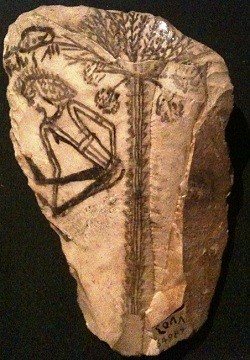
Marker and pencil on lined paper




Dawud al-Ta’i passed along the lane of ‘Amr b. Hurayth, where there were baskets full of ripe dates in even rows. On seeing them, his soul began to crave them. "Let's go," he said to his soul, and went to the vendor and said, "Give us one dirham's worth." "And where's the dirham?" the vendor said. "I'll give it to you tomorrow," Dawud said. "Go on about your business," the vendor said.
A man [in the crowd] spotted Dawud and said to the vendor, "What did that man say to you?" The vendor said, "He said: 'Give me one dirham's worth of dates.'" At this, the man held out a sack holding one hundred dirhams, and told him, "Here. If he accepts one dirham's worth of dates from you, you can keep the rest."
When the vendor caught up to Dawud, he was berating his soul, saying: "You, who are not worth one dirham in this world, you wish for Paradise?" The vendor said to him, "Come back, and take as much you need."
"Get away from me," Dawud said, "I was just testing myself.”
From The Merits of Abu Hanifa by Ibn Abi 'l-‘Awam
⯁
Sufyan al-Thawri passed along the lane of ‘Amr b. Hurayth, together with a man who gawked left and right at all the fruit on display. When they arrived at the gate of Musa ibn Talha [in the neighborhood of the Kunasa, which was Kufa's refuse depot], the man stepped in human excrement. Sufyan said to him: "Everything you were gawking at turns into this."
From Finding Faults and Findings in Favor [of Individual Hadith Narrators] by Ibn Abi Hatim al-Razi
I am informed by Tahir ibn Muhammad al-Ahwazi, who said:
I saw Abu Hayyan al-Muwaswas after he went from Basra to Baghdad. His only care was for the purchase of a wide-mouthed ceramic jug, which he filled with water from the Tigris and took to the canal of al-Sarat to pour it out. Then he would carry water back from al-Sarat and pour it into the Tigris. And from the time he came to Baghdad until his death, he did no other work but this. When night fell, he would set down his jug and weep over it, saying, "Dear God, lighten for me the task I am performing, and relieve me of it!"
I am also informed by Muslim ibn ‘Abd Allah, who said:
I saw Abu Hayyan al-Muwaswas when he came to Baghdad and conceived his passion for pouring water. He would carry it from one place to another to pour it out, and when asked about it, he would say, "If I don't do this every day, I'll die."
And here is one of Abu Hayyan's poems (meter: munsariḥ):
Weep no more for Hind, nor the level sands,
nor springtime pastures known by you,
but stop at Qatrabull and its amusements,
tether there your camels from the trek,
and stop in on the old man of the monastery
whom People of the Book call the Qissis.
He's not amassed a fortune. All that he owns
is his crucifix and a bell.
But he has a wineskin over his shoulder that he brings
to be my portion, carrying it spout downward.
On my first visit, I frightened him, and he quaked at me,
so I mentioned Moses. "[How about] Jesus, though!" said he,
and poured into my cup a bright, clear, unmixed stream
from a vineyard where no grubs have breached the vine.
Abu Hayyan's speech became disordered at the end of his life when he went mad. But he was not disordered in his verse. This is the way of poets who suffer dementia late in their careers: their speech becomes profoundly incoherent, but when it comes to poetry, they transcend [the confusion in] their heads, and follow the traces that were familiar to them before their madness.
From The Rankings of the Poets by Ibn al-Mu‘tazz
‘Abd al-A‘lā ibn Ziyād al-Aslamī said: One day I saw Dāwūd al-Ṭā’ī standing on the bank of the Euphrates in a state of amazement. "What has made you stop here?" I asked him.
He said: "Look at the eddies in the river, and how they whirl in obedience to God’s command, be He exalted."
From the Ornament of God's Friends of Abu Nu‘aym al-Isbahani

Roberto Harrison, "buffalo person for the morning" (2020).
Pencil and ink on paper, 12.7 x 17.8 cm.
From the series Tec Alliance
Ibn Khālawayh said: In the speech of the Arabs, khaḍir / khaḍira is used for just five things. (1) Al-Khaḍir is the name of a prophet, God's blessings and peace be upon him. He was called that because when he sat on a patch of ground, it sprang into greenness beneath him.
(2) Khaḍira is an epithet of the world here below. The Prophet of God, God's blessings and peace be upon him and his family, said: Al-dunyā ḥulwatun khaḍiratun ("This world is sweet and green").
(3) Whatever is said to be yours khaḍiran naḍiran ("green and flourishing") is free for you to take it. [The dual noun] al-khaḍiratān is heard in the expression for "Two things that are ever green: sakhbar and raiding"—[as if they were] two bushes, their freshness surpassing all other green things. In other words, one is impelled toward them both.
(4) Khaḍir is any green herbage that the earth puts forth, whether trees or panic grass or lush greenery [The IXth form verb] ikhḍarra is used for this, and for a tree whose greenery is plentiful.
The Prophet, God's prayers be upon him, said: "Refrain from those plants in your diet (khaḍirātikum) that have a strong smell," meaning garlic, onion, and leeks.
Palm trees too are called khaḍir. And khaḍir can refer to a dish of tender greens. Ukhtuḍira, [a passive VIIIth form verb meaning "to be cut off in a state of greenness"] is said of someone who dies in their youth, leaving nothing finished.
(5) And Khaḍir is the name of a tribal group.
From volume 5 of
The Book of "Not in the Speech of the Arabs"
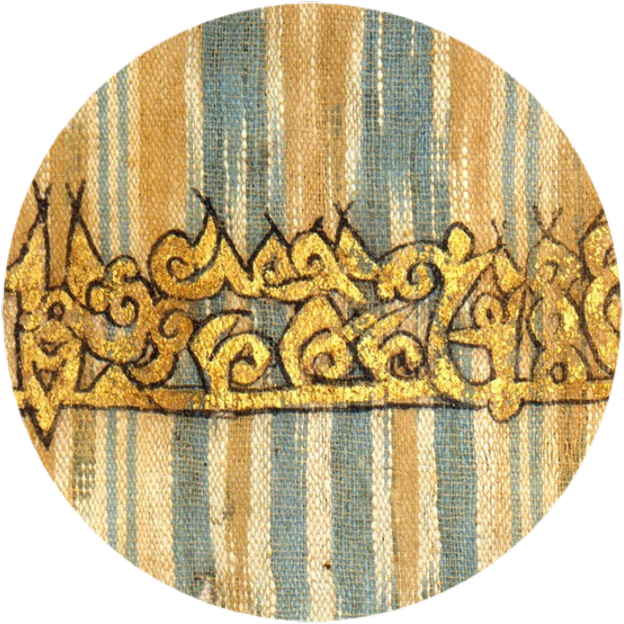
by Ibn Khalawayh (Süleymaniye MS Shahid ‘Ali Pasha 2143, fol. 20v-21r)