
February 15, 2021

Gem therapy

Abu ‘Abd Allah al-Ḥusayn ibn Aḥmad ibn al-Jaṣṣaṣ was a superlative individual in several respects. One was his eye for gemstones, in which his connoisseurship was unsurpassed. Another was the opulence of his lifestyle, for which he was called the "Croesus of the Faithful."
    [Yaḥya ibn] al-Munajjim sent an epistolary poem to the judge ‘Ali ibn ‘Abd al-‘Aziz with these verses (meter: khafif):

     Not everyone endowed with wealth, O Ibn ‘Abd al-‘Aziz,
         obliges those endowed with [only] hopes.
     Please take away the likes of Ibn al-Jaṣṣaṣ.
         Instead, give me the likes of Ibn Barmak.

The verses cost Ibn al-Jaṣṣaṣ his freedom, and a fortune worth 10 million dinars was seized from him. On his release, he saw a hundred camels being led from his estate to the public palace, loaded with bales of canvas. At this he appealed to the caliph's mother, who secured their restoration to him, for she had been much pained by the jeweler's punishment. These camels had just arrived from Egypt, [loaded with two bales apiece,] and the merchandise in each bale was worth a thousand dinars. And on the spot he turned a profit on the confiscated items.
    Ibn al-Jaṣṣaṣ kept a selection of precious stones in a compact case that he would reach for any time he was anxious, and revolve them in his chambers until his worries went away. This is what he was doing, in his seat by the pool in his cloistered garden at the time of his arrest, when he leapt up and strewed the stones amid the aromatic plantings.
    After his release from carceral inquisition, Ibn al-Jaṣṣaṣ went back to his garden. All the plantings had withered away, but his despair was for the lost stones. Then he began looking around the place, and discovered beneath the withered vegetation that the stones were still there, untouched by human hands, birds' beaks, or the predation of rodents. And as Ibn al-Jaṣṣaṣ gathered up the precious stones, his injured spirits recovered their strength.

From the Book of Precious Stones of al-Biruni

January 28, 2021

The Mu‘allaqa of ‘Abīd ibn al-Abras

appears in translation with an introduction by me
in

The title of the book 'The Mu‘allaqat for Millenials: Pre-Islamic Arabic Golden Odes' appears on the book’s cover in English and Arabic, as if written on an antique scroll.

A public-access publication 
of the King Abdulaziz Center for World Culture (Ithra), 
in cooperation with Al Qafilah magazine, 
produced by Saudi Aramco (Dhahran, 2020)

I would not have missed the chance to work with this team of editors and translators for the world. Many thanks to Hatem Alzahrani and Bander Alharbi. This is my first commissioned translation. My fee went to Climeworks.

January 21, 2021

Our poems are the best and travel far

I am told by Muhammad ibn Yahya [Abu Bakr al-Suli] that Muhammad ibn Sallam said: I was told by ‘Umar ibn Shabba that Muhammad, the son of Bashshar ibn Burd said:

Marwan ibn Abi Hafsa was reciting his poems before my father. He said, "If I could add some of your verses to mine I would be rich." At this, my father invited his rhapsode to recite them. So he recited a poem of Bashshar's rhymed in lām, and, when he got to the verses (meter: ṭawīl)—

    A depiction of you has been sent abroad by me.
      Off [my poem] went, and did not fail to arrive at inhabited areas.
    To the East and West I cast it, and the land swarmed
      with its reciters and travelers [who recited it elsewhere]

—Marwan said, "O Abu Mu‘adh! [That is, Bashshar.] Other poets are storks, but you are a falcon."

And Muhammad ibn Yahya said:

Bashshar's verse was imitated by Muhammad ibn Hazim al-Bahili (meter: wāfir):

    The meaning I intend forbids I make my poem long.
        My expert sense of [formal] correctness does the same.
    By making a short selection, and employing brevity,
        I shall curtail the length of my answer,
    and when I perform it for parties of travelers
        rhapsodes and riders will say it back to one another.

From The Ornament of the Learned Gathering
by Abu ʿAli Muhammad al-Hatimi

December 28, 2020

The Poem of the Bow

by Ma‘qil ibn Dirar, called al-Shammakh
(floruit 1st half of the 1st century A.H.),
appears in issue 29 (2020) of A Public Space
وبالعربية ت صلاح الدين الهادي
Thanks to the editors

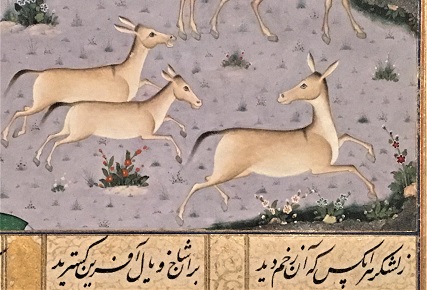
Three onagers (wild asses) run in a rightward direction across a plain that is dotted with stylized flowers. The onager in the lead looks back over its shoulder at the other two, and the rearward onager opens its mouth as if braying aloud. Below them, a verse of Persian poetry is written in black ink on a golden background.
Detail from a folio of the Shahnameh of Ferdowsi,
illuminated by Mir Sayyid Ali and workshop (ca. 1530-1535).
Previously owned by Shah Tahmasp I, now at the Met

December 22, 2020

Alexander the Sleepless IV

Then he heard of a city ruled by activity of the Evil One, where adoration of idols was a non-stop festival and the people rejoiced in sacrilege. Alexander braced his loins with the preparation of the Gospel, charged up to their celebrated temple and set fire to it, and pulled it down with godlike power. The prize was his, nor did he decamp from it, but made his seat there in the temple.

The people of the place were apoplectic, and they raced up to put him to death, but at a blast of discourse from the man their tempers withered, and they retreated. The protecting grace of God was at work, as Alexander let out the apostolic cry: "I am a man who suffers as you do, and have wasted time like you on useless things. Flee eternal damnation. I recommend to you the kingdom of heaven." And things went on like this, and from all harms that they attempted the noble athlete was safe.

Then citizen Rabbula—a city father, thanks to his powers of wealth and rhetoric, who went on to become a denouncer of idols and a herald of the truth, but was then a raving idolater and a henchman of the Devil—addressed the mob in a loud voice: "Brothers! Fathers! Abandon we not the gods of our fathers, but let us complete our sacrifices according to tradition. The gods remain aloof from this Galilean who damages them. If they do not defend themselves, it is due to humanitarian reasons, or to the greatness of the Christians' god."

Encouraged by his mastery of the mob, and benighted by the Devil's every wile, Rabbula told them, "I shall go up to him by myself, and purge our temple of his magic and deceit, and right the wrongs he has done to our gods and to all of us." And he went up full of bluster, and engaged Alexander in dialogue. [....] He said, "I am eager to learn the full extent of your mania. What impels you to keep up this abuse of our gods? It has us dumbfounded."

The blessed Alexander heard his words, and said, "Listen to the power of our God and the mystery of our faith."  He went on to speak of God's good will toward men, and the power of the holy scriptures, beginning from the creation of the universe up until the investiture of the cross. All that day and all that night, the dialogue went back and forth between them, and they kept themselves from food, and did not give themselves to sleep....

Rabbula chortled and said to the blessed Alexander, "If these things are true, and your God is, as you describe him, so attentive to his servants, then pray to him for fire to come down right in front of us. If that happens, I will declare that there is no god but the god of the Christians—since, as you say, you are his servant. But your scriptures are in truth falsehoods."

The blessed Alexander had no doubt that God would assent to his request, since it is written that "All things are possible to one who believes." He said to Rabbula, "Call on your gods, since there are so many of them, for fire to come down. I too will call on my god for fire to come down, and set alight the woven mats that lie before us."
   "I lack the authority to do so," said Rabbula. "You go ahead."
    At this, the holy Alexander arose, boiling over with the spirit, and said, "Let us pray." Facing east, with his hands outstretched, his prayer was such that Creation was set in motion, and fire came down and ignited the mats placed round the temple, just as the noble athlete had said. The men were unharmed, but Rabbula was overcome with wonder, and, thinking he would be ignited also, fell to the blessed Alexander's feet and did not let go until the fire had subsided, saying then in a loud voice: "Great is the god of the Christians!"

From The Life of Alexander the Sleepless (II.9-11, 12, 13)

December 14, 2020

Alexander the Sleepless III

Alexander spent four years in Syria, fighting the good fight, and his progress in the Lord was substantial. Although he adhered to every rule, he remained keenly attentive to whether monastic life were lived in accordance with holy scripture, and found that it was not. As devotees well know, the renunciation of wealth and care for the future enjoined in holy Gospel is not maintained in cenobitic life, where it is someone's job to provide for the brothers and attend to their needs. But Alexander was a slave of God, boiling over with the Spirit, and the words of the Master—"Take therefore no thought for the morrow" and "Ye are of more value than many sparrows"—were forever in his ears, and his inner turmoil could not be contained. [....]

With the Holy Gospel in his hand, he strode up to the abbot and asked, "The things that are written in the Holy Gospel, father—are they true?"
    Now Father Elias was a father indeed, and the shepherd of an inference-making flock, and on hearing the blurted question he surmised that the Evil One had led this brother away from faith. Straightaway he fell with his face to the floor, and said nothing to Alexander but called to the others, "Come pray for this one, who struggles in the Devil's trap!" And for two full hours all the brothers wailed over him, begging God for aid.
    The abbot then got to his feet and said, "How comes this question to you, brother?"
    Alexander was undeterred. "Are the things in the Holy Gospel true, or are they not?" he asked.
   "Yes," they all replied, "because they are the words of God." 
   "Then why do we not carry them out?"
   "Because no one is able to." they said.

At this, Alexander's outrage was unrestrained. To be cheated into wasting all that time! He took his leave of the entire community and, clutching the Holy Gospel, set out to follow what is written there in imitation of our holy fathers. Hereupon, the prophet Elijah became his model, and he made his home in the desert, where he spent the next seven years heedless of earthly cares, living as the Holy Spirit dictated.

From The Life of Alexander the Sleepless I.7, 8

December 7, 2020

Alexander the Sleepless II

The blessed Alexander was an Asiatic Greek from a noble family of the Aegean Islands. He studied the full course of literary sciences at Constantinople, and this was a complement to his moral education, which had developed his Christian piety and honest virtues to their full extent. His training complete, he entered government service, where he soon discovered how corruptible and fickle life is, and that "like a flower of grass" earthly glory too is fleeting. He came to despise his mundane existence and resolved upon a better way of way of life. He put the Old and New Testaments through rigorous philological inquiry, finding in the Gospels a treasure beyond assail for those who go forth trusting in the one who said: "If you want to be perfect, sell everything you have and give it to the poor, and your treasure will be laid up in heaven. Then come follow me."

When Alexander heard this, his conviction was total, and straightaway he took his share of inherited capital along with his earnings as prefect (an office he had discharged with fairness and nobility), a substantial sum, and gave it all to the poor and needy. His hope was then to isolate himself from friends, family and fatherland, and for Christ alone to be his intimate and lord. And he heard that communities of holy men were reverently pursuing this way of life in certain parts of Syria.

From The Life of Alexander the Sleepless (I.5-6)