March 13, 2023

Alexander the Sleepless XVI

The blessed one reflected on the zeal and faith he observed in the brothers and the magnitude of their devotion. What could this mean? Through the Holy Spirit, it dawned on him that even in these quarters he was being called to wage the struggle. Energized by this conclusion, he made himself ready, and prayed for Christ's will to be done swiftly. And God, Who loves humanity, was swift to answer his prayer. 

Alexander took up residence near the shrine of the sainted martyr Menas, and within a few days there flocked to him noble athletes of Christ out of every monastery in the area—three hundred of them, all sound of mind, belonging to three races: Romans, Greeks, and Syrians. To fulfill his mission of hymn-singing without pause, Alexander separated them into six groups, and schooled them in monastic poverty, molding everything after the pattern of his old rule. Within a matter of days, the hierarchy he laid out was ordered as to every virtue, and the basis for their struggle was made plain to all. For he grouped them in tens and fifties, ordaining decarchs and penetecontarchs to lead them, and hourly they poured their strength into singing the praises of God.

On beholding their systemized struggle, their ceaseless hymn-singing, their immaculate poverty, and the incredible mysteries made no less wondrous by the evident truth of their accomplishment, the commonfolk of the city came devoutly to Alexander as a benefactor and teacher, and inhaled his teachings about hope and the life to come. Before long, he had become the harbor of salvation and educator of justice for all. When he was silent, his life gave continual voice, crying its admonishments aloud against the adulterators of God's commandments, while his free and unrestrained speech excoriated the unrepentant. Above all, though, it was seeing the extremities of poverty the brothers took on, and the severity of their discipline, and the fact that their possessions were limited to parchments containing the holy scriptures, and their capacity for singing hymns without pause, and the bodiless way they inhabited their bodies—it was seeing all these things that roused the people's astonishment and praise of God, Who had revealed His incredible mysteries even in those quarters.

The Life of Alexander the Sleepless III.43-4

March 4, 2023

A Poem Is a Mantle  
of Resist-Dyed Weave  

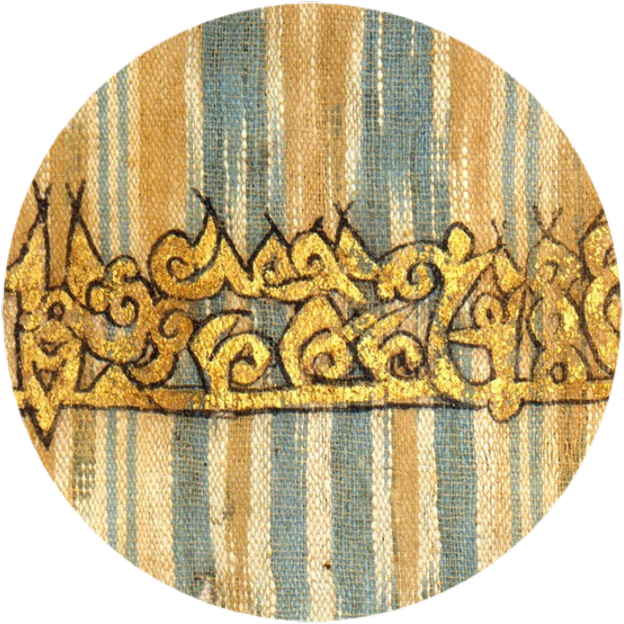
A detail of a fabric woven from blue, tan, and ivory threads with a band of pseudo-Kufic writing painted in gold
Resist-dyed textile fragment; cotton; with pseudo-Kufic script in gold leaf (detail).
Yemen, 9th-10th centuries CE. Cooper Hewitt Museum

In how many ways is a poem like a robe? Don't make me count them. Whatever answer works for you intuitively is probably fine. For instance, texts and woven things are alike the products of cumulative effort—a likeness with no basis in etymology, history of technology, or any domain but practical experience to prove that it is so. You could call it a truism, or an apothegm, or (why not) a universal truth.

In early Arabic poetry, the analogy is not so multivalent. It is under specific circumstances that Arab poets of the 6th-8th centuries CE compare their work to textile craft, and to a specific textile form. Let me tell you about it, after answering one "so what" question that makes this more than a matter of antiquarian curiosity.

Since the 9th century, Arabic prose writers have been eloquent about the ways in which poetry is a craft like weaving (nasj) or the ordering of pearls on a string (naẓm), to the point that nasj and naẓm became synonymous with poetry itself (shi‘r). I don't like to say this is "well known," but it is comparatively well studied since Abdelfattah Kilito's 1979 article. Meanwhile, what the poets actually said about their poetry, in their poetry—the boasts they made of it and the similes they coined for it—is mostly ignored, and a lot of important social information along with it. What effects did theA frayed weaving of blue, tan, and ivory-colored threads, crossed by a horizontal band of pseudo-Arabic script painted in gold leaf.
poets think they were accomplishing through their work? That information is available, if you read what they say about their poetry, and what they compare their poetry to.

Take fabrics. Early Arab poets mention different types of cloth imported from different places (Egypt, Syria, Persia), and very rarely Arabian homespun. But when they say their poem is like a robe, it is a specific type of weaving that they reference: a striped cotton mantle made in Yemen of resist-dyed weave (a forerunner of Indonesian ikat). In collections in the US and Canada there are examples dating to the 9th and 10th centuries, many with bands of pseudo-Kufic writing in gold leaf (as pictured here).

This style of weaving is mentioned in an enigmatic verse by Aws ibn Ḥajar, a poet of the sixth and early seventh century (meter: ṭawīl):

               When people rush at me in angry temper
                   I deck them out, marking them with fine, striped raiment
                       (kasawtuhumu min ḥabri bazzin mutaḥḥami).

I say the verse is "enigmatic" because it appeared in an anthology of enigmatic verses by Ibn Qutayba, who glossed it like this:
    "Mutaḥḥam (striped) is an epithet of the garment he makes out to be al-atḥamī, which is a variety of Yemeni mantle. 'I deck them out in the very best of that type of garment,' he says. But this is a similitude, meaning 'I besmirch them in verse, and [the effect] is as evident as if they went dressed in these garments.'"
      In other words, Aws is not talking about donations of fine clothes (as Geyer thought). He is saying that the object of his invective versecraft is marked out and made conspicuous, as if by an attention-getting robe. The atḥamī robe is defined by al-Aṣma‘ī as "a resist-dyed mantle of Yemen without embroidery," looking maybe like the ikat fragment pictured here.

The true keyword of Aws's verse is ḥabr. Dedicated readers of early Arabic poetry are well acquainted with cognates of this word, which name the genre of Yemeni mantle that atḥamī weave belongs to. Historians of Islamic art know the stuff too (see Vera-Simone Schulz, "Crossroads of Cloth," for references), but between resist-dye weave as material artifact and poetic signifier the correlation has been made by exactly no one until this blog post. When it is laid out in Hands at Work, the reader will gain access to something rare, and that is the chance to envision early Arabic poetry as it was conceived and represented by the poets themselves.

A detail of the same textile fragment appearing elsewhere on the page